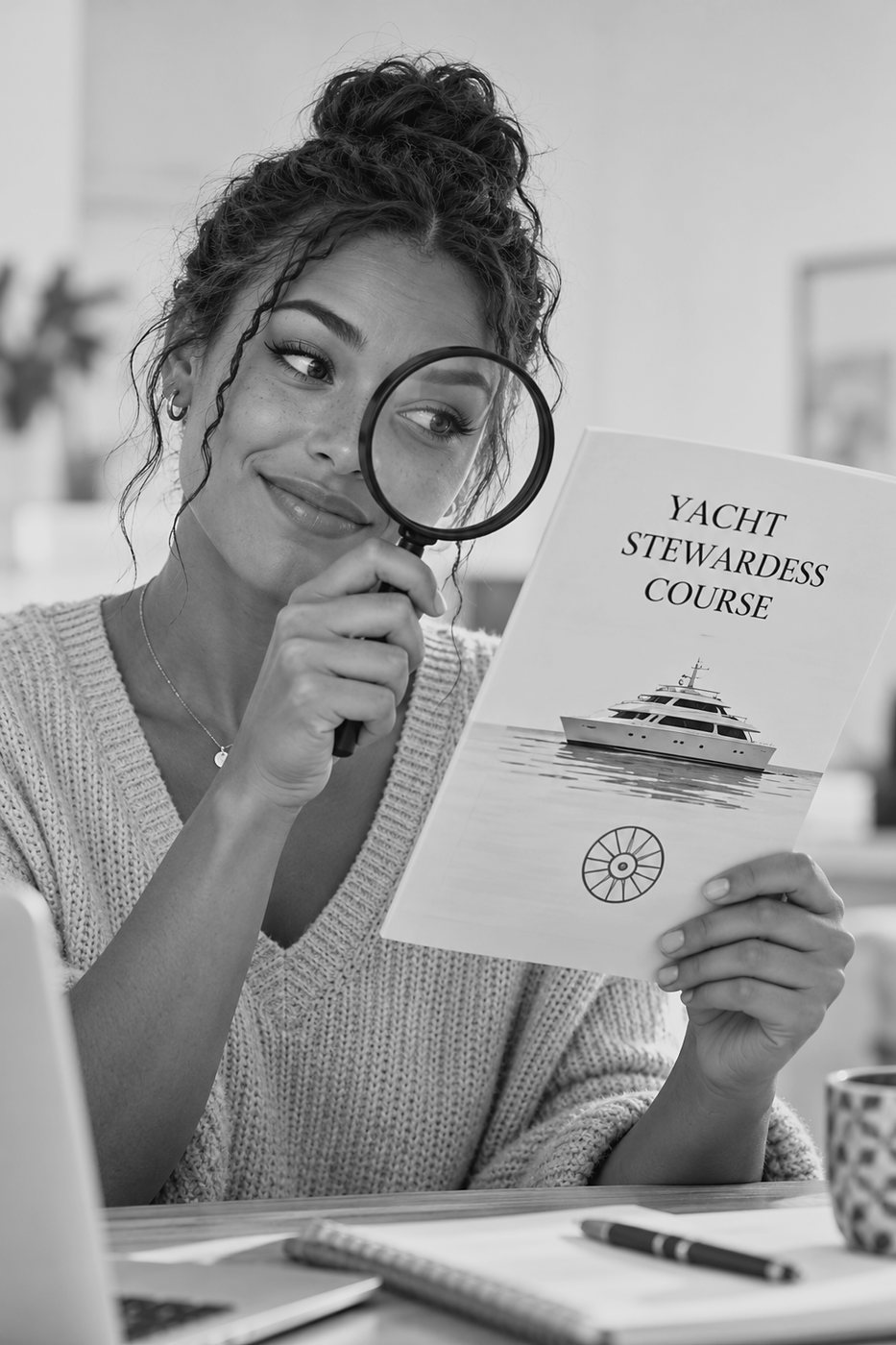
A young woman at her desk peering through a magnifying glass, smiling, while holding a yacht stewardess course brochure

Before You Book

What to Look For in a Yacht Stewardess Course

It’s late at night, many tabs are open, and you’ve already pictured yourself serving sundowners on deck.

Now you’re comparing prices and content, trying to narrow it down. Training is a big investment, and you want to be sure it suits you. Your choice may come down to location, cost, available dates or class size, and these days there are online options too. Most new stews train over the winter and spring, ready for the busy Mediterranean season, so it’s worth knowing early what suits you, your pocket and your existing knowledge.

Deciding to work on a yacht is exciting. Or maybe it wasn’t a decision at all, more a strange twist of fate: an opportunity knocked and you opened the door. Either way, here you are, choosing which course is best for you.

What Do You Need to Work on a Yacht?

A good set of personal skills matters, and so does the essential certification. For entry-level interior roles, STCW Basic Safety Training and an ENG1 seafarer medical (or an accepted equivalent) are the standard requirements, and most agencies and yachts expect to see both. Knowing you’re trained in fire fighting, first aid and survival at sea gives you and your fellow crew peace of mind should an emergency arise, and regular drills onboard keep those skills fresh rather than parked up and forgotten. Your ENG1 confirms you’re medically fit to work at sea.

A few extras are worth knowing about too:

  • PDSD (Proficiency in Designated Security Duties): many yachts ask for it, and MCA-approved providers now offer this one-day security course fully online.
  • Food Hygiene Level 2: often requested for interior crew.
  • Hands-on safety training: STCW Basic Safety Training includes practical fire fighting and sea survival, so make sure any course you book has a hands-on element, as the MCA won’t accept safety training without one.
  • A welcome update: newer Basic Safety courses now also cover preventing and responding to harassment onboard, good news for every crew member.

It helps to separate three things: the safety qualifications you need to work at sea, the optional interior training that prepares you for the role, and the accreditation that shows a training course has been independently reviewed. Exact requirements can vary with the yacht, its flag and the role.

Interior training gives you the confidence to do the job and helps your working days flow. Working onboard is quite different from a hotel or restaurant ashore: you work in compact spaces, follow each yacht’s own systems and standards, live alongside your colleagues, and deliver guest service that can run from early morning until late at night. Learning those differences, the skills and the standards can improve your chances of employment and longevity onboard. Whether you have no hospitality experience or you’re an experienced restaurant manager, some interior training will help, as you may find the skills you have and the skills you need don’t quite align.

In Hindsight

When I joined yachting, I relied heavily on my hotel and hospitality background and went straight onboard without a course. In hindsight, a course would have been a real bonus. It would have given me a much better understanding of what was expected in my yachting career, a little more confidence in my duties, and a refresher on some existing skills, along with a few bad habits that had formed over the years!

Who Will Be Teaching You?

Some schools have a different teacher for each module, bringing in specialists for floristry or coffee, while others keep one tutor throughout, teach small groups or, in my case, train one-to-one. Whichever you choose, look for someone who has done the job and can tell you what the manual leaves out.

“
Knowing the job and knowing how to teach it are two different skills, and the best trainers have both.
Close-up of hands folding a crisp white napkin beside a small kitchen timer and a stack of folded napkins

How Much Time Will You Get to Practise?

There are layers to learning: reading the manual, listening to your trainer, following the demonstration, then having a go yourself, over and over again! Your future guests will never know how many napkins you folded to get there.

Practice makes perfect, and high standards are expected from your very first day of service. So having time during your training to practise, and to ask questions until you understand, is important. Class size or the time given to each topic may limit this, so look for training that offers real hands-on time. Most of us remember what we do far better than what we read or hear.

What Does the Certificate Mean?

A yacht interior certificate shows future Captains and Chief Stews that you’ve completed formal training, and gives them a picture of the skills you bring. Many courses carry industry accreditation, and AiMZ courses are independently CPD accredited. Each accreditation body has its own criteria, so it’s worth asking who accredits a course and what that covers.

A certificate can help your CV stand out, and it gives you a quiet self-assurance when you first step onboard. Crew agents and Chief Stews will look closely at the person too, though: your attitude, your personality, how you’d fit the yacht and the experience you bring.

“
Your training opens the door, and you are what gets you hired.

What Happens After the Course?

So, you’ve chosen your training, completed the course, and now you’re here. What’s next? Finding your first job onboard! It’s exciting, a bit of a rollercoaster and another learning curve: the agencies, the registrations, the interviews, understanding yacht cultures. Then comes settling into crew life onboard, where you’ll quickly discover just how cosy a crew cabin can be. The adjustments are many, and having support can make a hard day better.

Support after the course varies from school to school. At AiMZ, I continue to guide students throughout their first season, and for some, the coaching and mentoring continues for many seasons, helping them keep improving and find that ideal position onboard.

Many first-season stews come back to me with stories and questions, often ones they weren’t comfortable asking their Captain or Chief Stew. Sometimes they feel they’re making mistakes or unsure of themselves in certain areas. Life onboard is different to life ashore, the days are long, and there’s so much to learn. Having someone who trained you, knows the life onboard and has time to listen, can be all that’s needed.

Your Before-You-Book Checklist

Take This With You

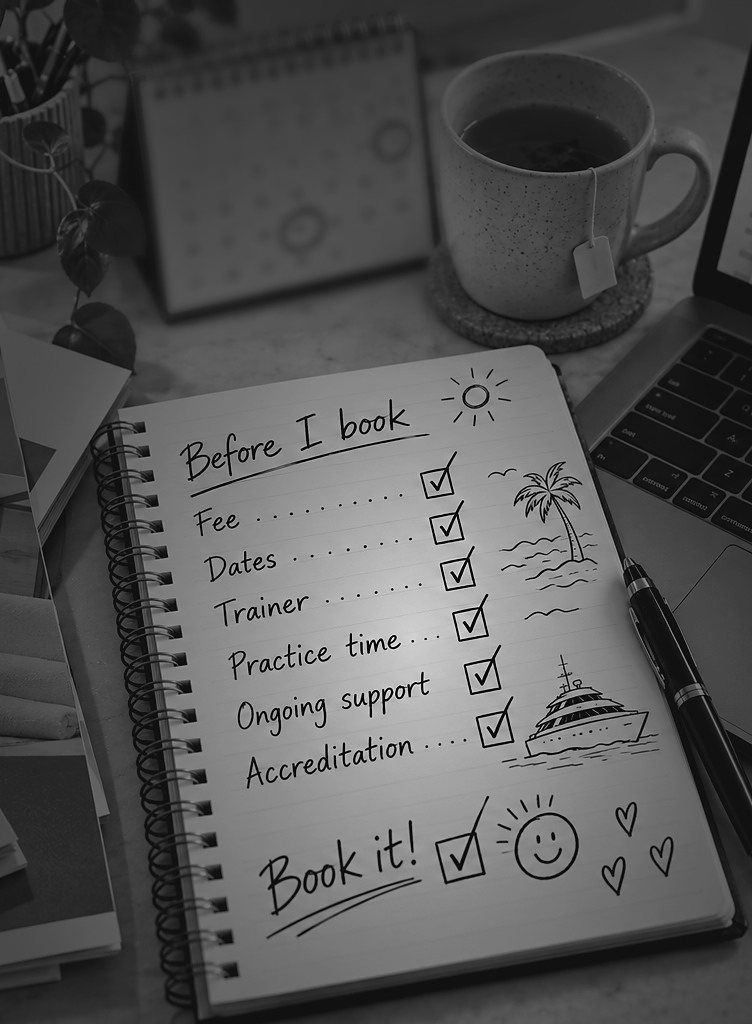
Whichever schools you’re considering, these are the questions worth asking each one:

  • What exactly is included in the course fee?
  • Do the dates, location and format work for me, and will I finish in time for the season?
  • Who will teach me, and what yacht experience do they have?
  • How much hands-on practice will I get?
  • What does the accreditation cover, and who provides it?
  • Does the training suit my existing skills and experience?
  • What support is available once the course ends?
A notebook on a lamplit desk at night with a handwritten Before I book checklist, ticks beside each item and little doodles, next to a cup of tea, a laptop and a desk calendar

And one for you: does reading about this make you want to start tomorrow? Good sign.

Which Course Suits Where You Are?

As you weigh up courses from different schools, the pros and cons, the cost and the time, it’s also worth looking at yourself: what you bring, what your past career has given you, and how transferable those skills are. From someone with no hospitality background to a seasoned hotel manager, finding the right course and the right pathway into yachting matters.

Recently, an experienced hotel manager from Scandinavia got in touch about becoming a Chief Stew. Her management skills were impressive, but she hadn’t yet done a season onboard, so we went back to basics, and a foundation course turned out to be a far better fit for her. Around the same time, a seasoned stewardess I spoke with felt she should take an advanced course. Once we talked it through, it was clear she was already well beyond that level, and she is now considering The Art of Leading instead. Two very different starting points, and two very different courses.

I teach students all over the world, and each one is unique in their experience and what they want to learn. That’s why First Step to First Season, my CPD-accredited foundation course, is tailored to each student. The right training builds on what you already bring and prepares you for what lies ahead onboard, so you step into your first season feeling ready.

If you’d like to talk through which course is right for you, I’m always happy to help.

Get in Touch Explore First Step to First Season
⇧