
My Own Experience
Someone told me I'd make a great stewardess. Then, completely unconnected to that conversation, someone else told me I should get into yachting.
I didn't know about yachting and investigated! I did my STCW course on the Isle of Wight. I got my ENG1 in Manchester. Someone told me to get a train to Antibes, there'd be loads of job offers for someone like me.
I did. There weren't.
I dockwalked along the coast of France for weeks. I turned up early every morning with the other greenies, waiting for the agencies to open. I registered with every agency I could, checked in online every day, and waited. Eventually I went back to London and carried on with my old job.
Then, out of the blue, a call about a job on a yacht. Are you available? I couldn't believe it!
I wasn't dockwalking, I wasn't in a yachtie hub, but next thing I knew I was on a flight to join a yacht to become a stewardess!
I hadn't attended a superyacht training school. My background in hospitality and management provided me with valuable, transferable skills that helped make the transition into yachting quite smooth. But there was still a lot to learn, to develop and understand, despite bringing years of experience. With the guidance of a great Captain who saw that potential, I found my feet and quite soon progressed to Chief Stewardess, and continued with the learning. That's how I became a stewardess. Looking back, I realise now that my path into yachting was anything but typical. And having that Captain, who had the time and patience to be my mentor on board, was priceless!
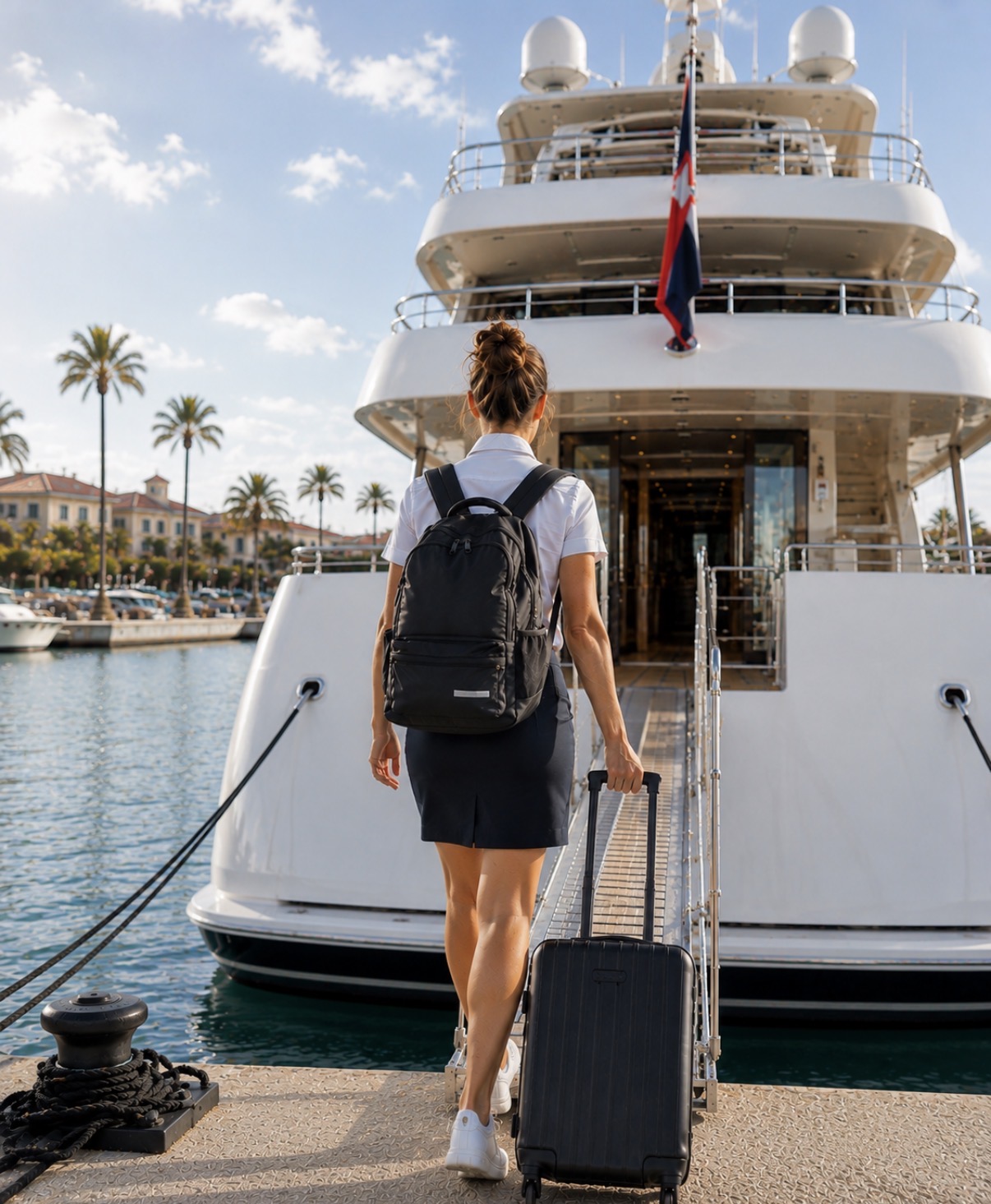
According to the internet, it’s quite simple. In reality, there are a few more steps, so here they are, one at a time.
Your Step-by-Step Guide
- Get your essential certificates. Two certificates come first, an ENG1 medical and STCW safety training, and many yachts also look for PDSD and Food Hygiene Level 2. Before You Book explains what each one covers.
- Choose training that suits you. Interior training is optional, and it helps you understand the standards before your first day. Look at who teaches, how much practice you’ll get and what support follows.
- Create a yachting CV. One page, a smiling photo, and your experience described the way a yacht reads it.
- Check your right to work, then head to a yachting hub. Antibes and Palma in spring for the Med season, Fort Lauderdale in autumn for the Caribbean, once you know your passport allows it.
- Register with crew agencies and get seen. Agencies, online crew sites, networking and daywork all open doors.
- Prepare for the interview. Presentation, punctuality and thoughtful questions make all the difference. From Green to Hired has the full picture.
- Get ready for your first season. Long days, shared cabins and plenty to learn, with lots of rewards along the way.
Congratulations! You've landed your first yacht job.
This is an incredibly exciting and daunting time. There's a lot to prepare for. Are you ready?
And there you are, on that luxurious yacht, somewhere off the coast of a gorgeous Caribbean island.
Only now you're on your hands and knees scrubbing the fourth toilet that morning. Your back hurts. You're running on six hours' sleep. You're wondering whether the owner actually likes you because they barely acknowledged you at breakfast. And you've just realised you haven't stepped ashore for five days.
But hey… you're a superyacht stewardess.
Which is exactly why getting your first season right matters so much. Stepping onto a yacht for the first time is about so much more than getting the certificates and landing the job. It's about understanding what you're walking into, knowing what will be expected of you and having the practical knowledge and confidence to hit the ground running.
This is where one-to-one training and coaching can make such a difference. Having a trainer with real industry experience to answer your questions and work through the situations you may encounter gives you a much stronger foundation.
I've met many aspiring stewardesses who have completed exactly the same training, but struggle to find work.
That's what made me question whether one approach really suits everyone.
Training Built Around You
Every person who walks through a classroom door is different.
Some arrive with years of luxury hospitality experience. Others have worked in aviation, hospitals, HR, retail, restaurants or customer service. Some have never worked in hospitality at all.
Good training builds on the skills someone already has, develops the ones they don't and prepares them for the realities of the job, not just the theory of it.
Professionalism, discretion, emotional intelligence, resilience and judgement are all important on board. So is the ability to remain calm under pressure, particularly when you're tired, the boat is busy and things aren't going quite to plan.
Those qualities aren't gained from technical training alone. They come through when a mentor or trainer takes the time to recognise what's already there, challenge you when needed and help you grow. As your skills improve, so does your confidence, and that confidence can make a huge difference once you're onboard.
It's the difference between learning how to do the job and becoming the stewardess every Captain hopes will join their crew.